

If your business runs on Notion, ask yourself:
If a team member (accidentally) deleted your client database, what would you do?
Most Notion users don’t have a clear answer. The platform’s backup options are scattered, inconsistently documented, and rarely set up proactively. That means most people are one bad click away from a very stressful afternoon.
This post maps out your backup options: native tools built into Notion, commercial backup services, scripted approaches, and one completely free method that preserves your database relationships and lets you do a full restore, which almost nobody is talking about. By the end, you’ll know exactly which layers of protection make sense for how your business actually uses Notion.
(As an asside, fears on Reddit about Notion going bankrupt or disappearing are overblown. By a factor of fifty or more, the real risk is user error, not infrastructure failure. If you’re using Notion with a team and haven’t configured your security settings, that risk goes up considerably.)
Here’s what we cover in this article about Notion backup.
- Exporting Your Workspace
- Restore From Trash
- Restore From the Edit History
- Commercial Notion Backup Options
- 4a. Backup Labs
- 4b NotionBackups.com
- 4c. Pro Backups for Notion
- Scripted Backup Options
- 5a. GitLab
- 5b. Selenium
- Free backup with live access to point-in-time snapshots
- Recovery From Complete Loss of Access
- You Triggered The 1000 Block Limit
1. Exporting Your Workspace
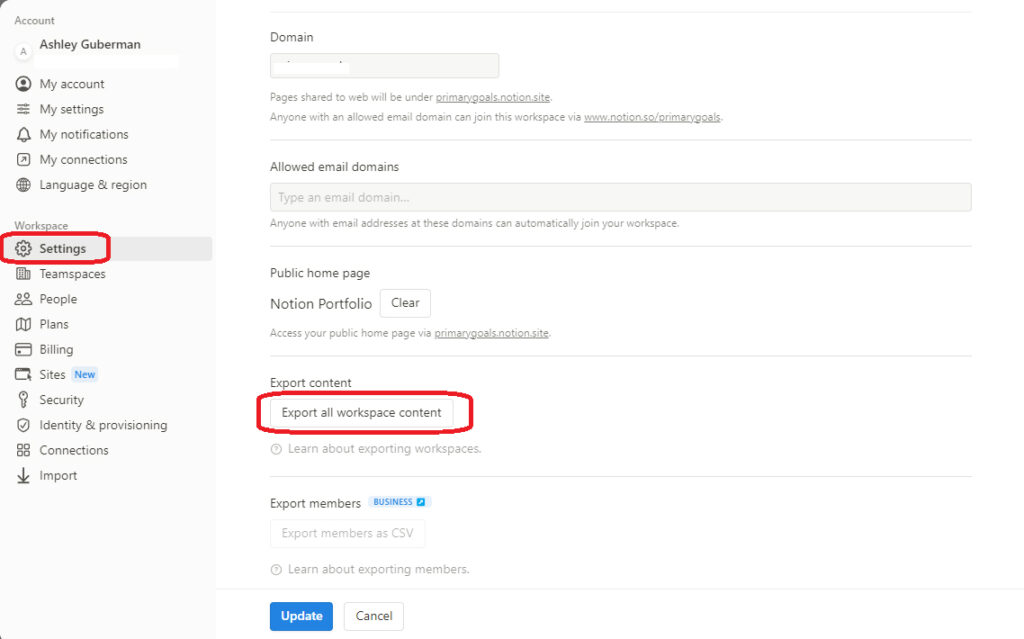
Benefits of Exporting Your Workspace
- Exports will get all your content from Notion and put it into a ZIP file.
- It’s great for putting into another storage medium or for compliance purposes.
- All files and documents you uploaded to Notion can be found in the ZIP for recovery or use.
- Database contents are exported in .csv format.
Where Exports Fall Short
- You have to trigger them manually.
- They can take a long time to produce.
- The export files can be huge (mine was 6 Gb).
- All database relationships are lost by reducing content to text in the CSV files.
- You can’t go backward from the ZIP file into Notion. There’s no “restore.”
2. Restore From Trash
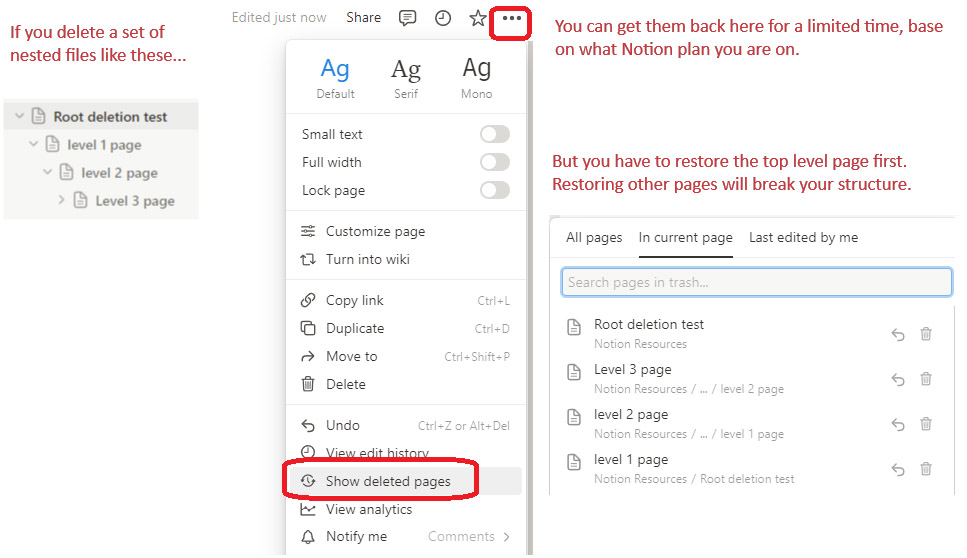
Benefits of Restoring Deleted Pages
- You don’t have to do anything for deleted pages to appear here.
- If you delete a page with many children, you can restore the parent, and all children return with it.
- It’s easy to use.
Where Restoring Deleted Pages Fall Short
- You have limited time to restore pages before they are gone forever. It’s 7 days with the free plan, 30 days with plus, and 90 days with business, covered on the pricing page.
- The UI could be better – showing a table of the file, path, who deleted it, and when, with sorts.
- You can only restore one page at a time.
3. Restore From the Edit History
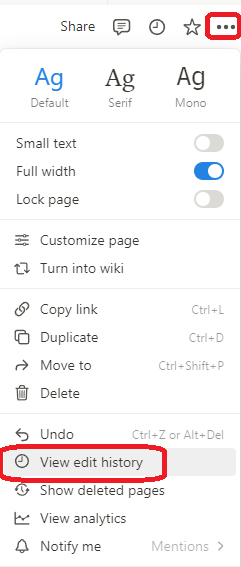
Benefits of The Edit History
- It’s like a time-based “Undo” for a single page.
- You can “view” a prior version, put something in the paste buffer without restoring the whole page, and then put just that piece back into your live page.
Where Restoring From The Edit History Falls Short
- Notion Backup points are in ten-minute intervals or two minutes after you stop editing. That might not be granular enough.
- If you delete something, keep working, and add new content, you must view prior versions and selectively copy back just the pieces you want. (This is true for any time-based recovery strategy.)
4. Commercial Options for Notion Backup
4a. Backup Labs
Benefits
- Free trial for 14 days, then about $10/month.
- Works with multiple SAAS products, like GitHub, Trello, GitLab, Jira, and Notion.
- The setup was easy.
- It made periodic point-in-time Notion backups that could be downloaded as ZIP files.
- The support team was responsive to emails.
Drawbacks
- My first two Notion backup attempts failed and gave no details. An email to support said it was an API error.
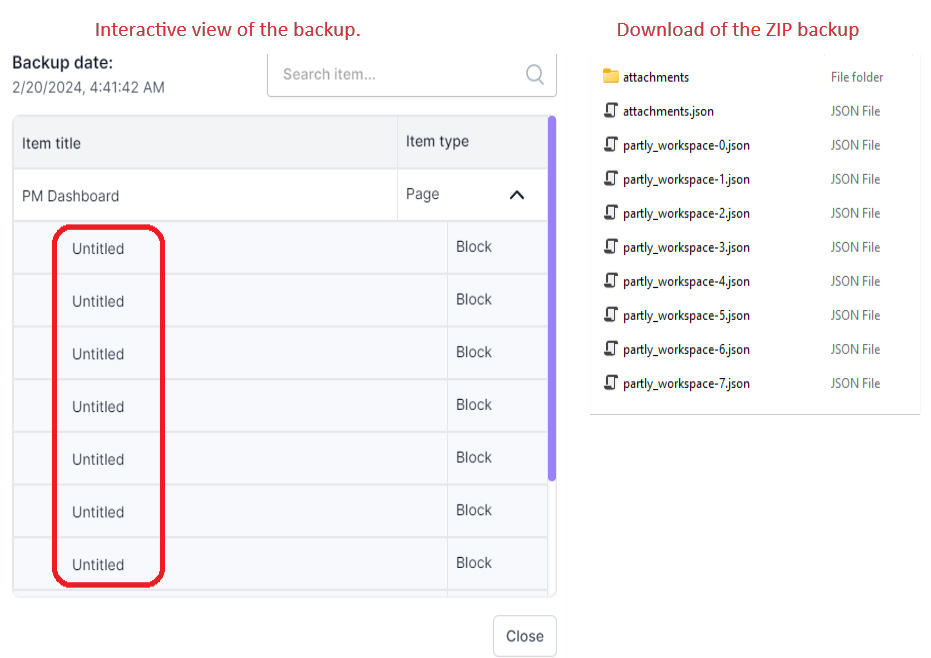
- My third backup worked, but viewing the backup proved less than helpful, with nothing but “untitled” under one of the page trees I backed up.
- Downloading requires that the ZIP file be processed first, after which there is a tiny window of 2 hours to download it.
- The ZIP file was a bunch of JSON files that are great for programs but harder to work with for most people.
4b. Notion Backups
Benefits
- Free, 10-day trial, then about $10/month
- Stores your data on one of
- Google Drive
- OneDrive (beta)
- DropBox
- Amazon S3
- BlackBlaze B2
- Multiple options for how often to back up and how long to retain Notion backups. The pro version includes advanced options for monthly and yearly retention as well.
- Includes the ability to back up comments on pages.
Drawbacks
- Once you connect your Notion workspace and a storage account, it’s unclear what to do to make the Notion backup happen.
- Your initial Notion backup will be scheduled, but “backup workspace now” does not say when it will occur or when it has started. (After about five hours, I saw it show up.)
- Other limitations about the current state of restoration are posted on their site.
- Windows cannot open the ZIP file (it reports corrupt), but 7-Zip works fine.
4c. Pro Backups for Notion
I haven’t completed a hands-on evaluation of Pro Backups yet. Based on their documentation, it supports automated Notion backups with restore functionality — visit their site to assess whether it fits your needs. I’ll update this section with a full breakdown once I’ve put it through its paces.
5. Scripted Backup Options
6. Notion Backup Using A Second Account
This is the only approach in this entire list that gives you true point-in-time snapshots you can actually interact with (browse, search, copy) without paying for a third-party tool. It also preserves your database relationships, which most export-based methods silently destroy.
How it works: Notion allows you to duplicate pages (and children) across workspaces. By creating a free secondary Notion account using a different email, there is no storage limit so long as you don’t add members. You can then maintain a running archive of dated snapshots of your live workspace. Because it’s a live Notion account rather than a ZIP file, you can open any snapshot and work with it directly, including manual restore of specific pages or records without rolling back everything else.
The trade-off is that it’s a manual process. It takes a few minutes each time, and you have to remember to do it. But for a business that runs critical operations in Notion, this is the most capable free option available. It’s also what I recommend as a baseline for anyone not yet using a commercial tool.
The process involves four simple steps:
- Publish a (root) page on your Notion workspace with the content you want to back up.
- Make a duplicate of that page from your live Notion account into your free account.
- Rename the copy you made to append a date stamp (e.g., MyWorkspace-2024.02.19
- Unpublish your live Notion page.
Benefits
- This is the only way to backup that lets you fully interact with all of the backup files.
- This is the only way that permits a full restore by reversing the direction in which you perform a duplication.
- All of the relationships between your databases are maintained.
- Creation and modification dates on your database records are maintained.
Drawbacks
- It’s currently a manual process.
7. Recovery From Lost Access or Deleted Account
I have to confess here. Many people complained about losing access to their accounts, and I smugly thought, “That would never happen to me.” Well, I was wrong. So, I learned how easily it can happen and what is required to get everything back.
There are three ways to leave (or lose access) to an account.
You are a paid member or consultant wanting to leave.
This method also applies if you deliberately kick somebody else off your account.
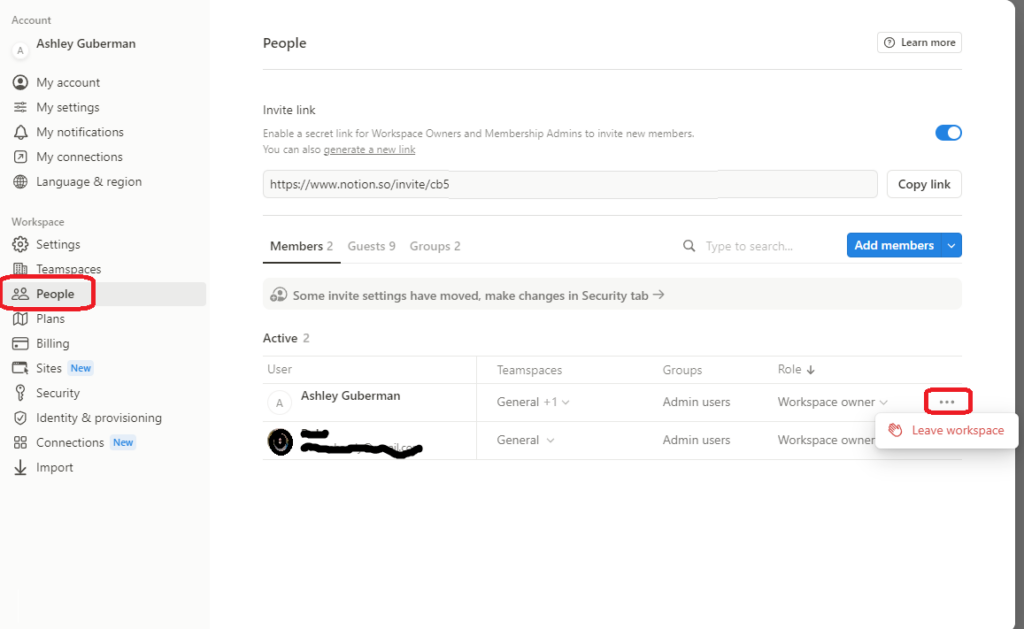
The danger here is that you could potentially remove your own account, locking you out. Fortunately, after taking this option, you get to confirmations like this:
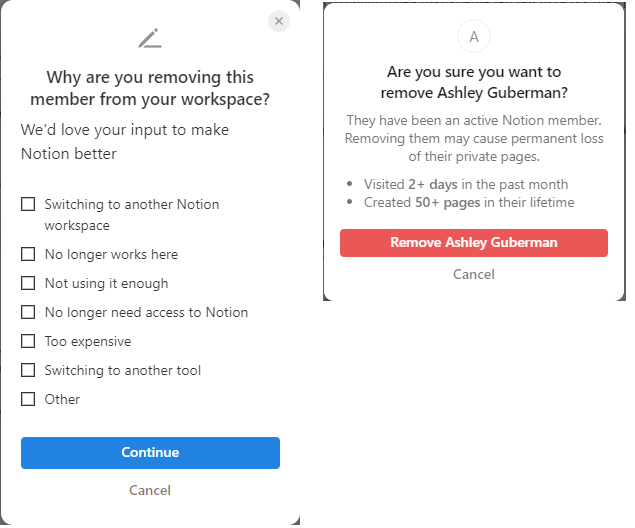
You are a guest of a workspace, and you want to leave.
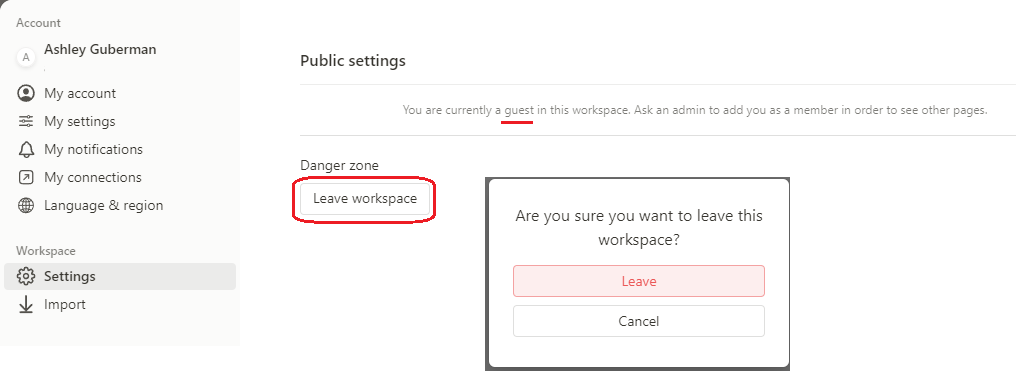
You Deliberately Or Accidentally Delete Your Account (rather than your workspace)
This is the most catastrophic one when you likely wanted only to leave somebody else’s workspace.
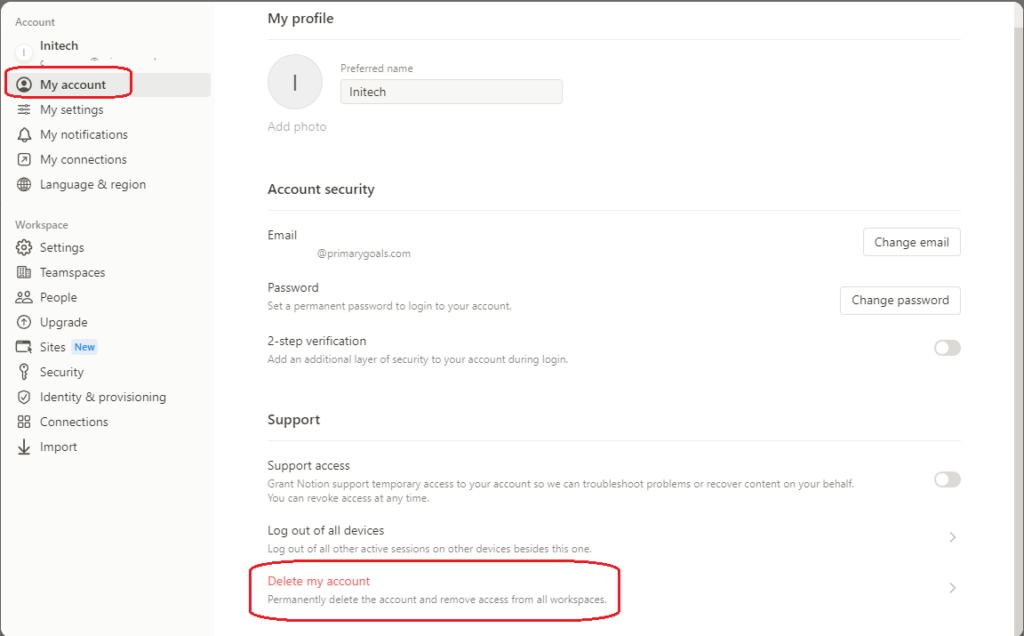
The confirmation here is more explicit, but if you know what to look for and the differences between the deletion options, hopefully, this will help you. (This is the mistake I made when I thought I was leaving a client’s workspace rather than my access to all of my accounts, both mine and my clients.)
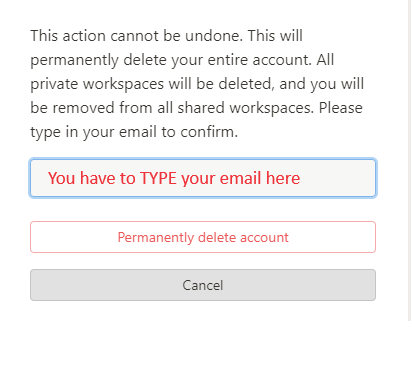
And after you make this horrendous mistake, you get the login screen. You think you’re logging back into your account, but you would actually be CREATING a brand new account using the same email address.
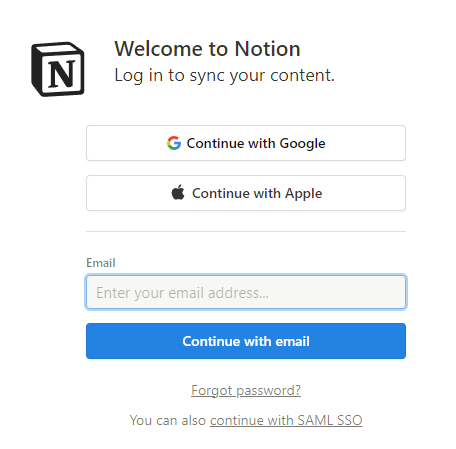
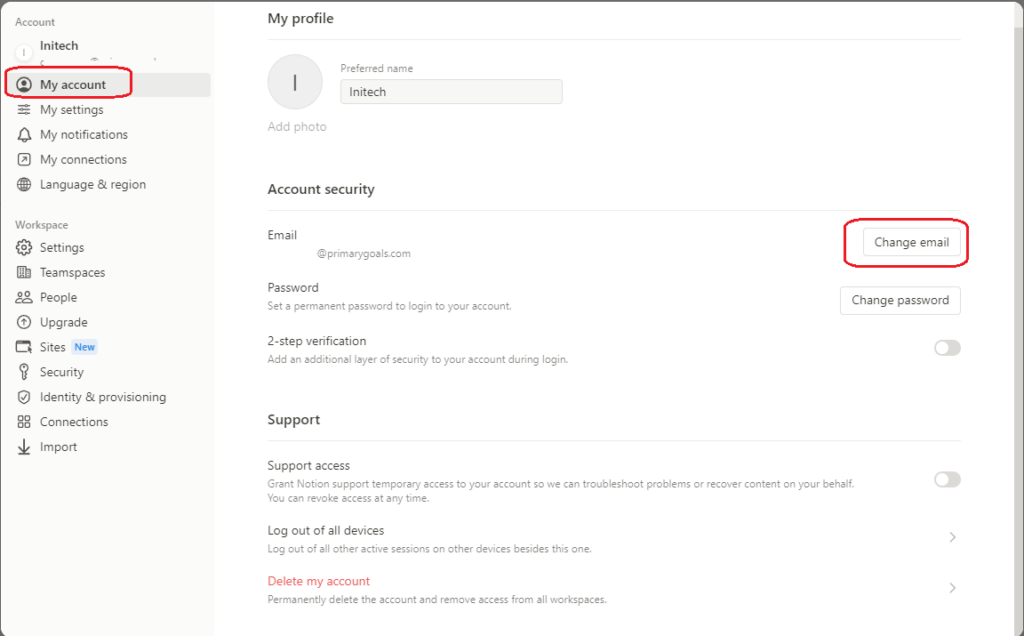
This last step, re-creating under the same email you just deleted, actually makes recovery by Notion support even harder. For them to restore your account (which can take anywhere from days to weeks or more), you need to have your original email available to hold the restore. So if you created a new account using the old address, you have to change the email to make a clear space for support to put the restored account like this:
You Are a Student On an EDU Account And About To Lose Email Access
How to retain access
1 – Grant admin access to a guest using a personal email. Good practice from day 1.
2 – Put pages under a few root pages, publish, and duplicate to a personal account, as covered in the section on Live Snapshots
Which option is right for you?
After walking through all nine options, here’s a practical guide based on how your business actually uses Notion.
Solo user, low complexity. Restore from Trash and Edit History are probably sufficient for day-to-day protection. Set a recurring reminder to do a manual workspace export once a quarter and store it somewhere outside Notion — Google Drive, Dropbox, anywhere.
Small team, moderate complexity. The free second-account method (section 6) is your best starting point. It gives you true point-in-time snapshots with full restore capability at no cost. Keep Notion’s built-in trash and edit history as your first line of defense for minor mistakes, and use the second account for anything more serious.
Business-critical workspace with client data. Don’t rely on a single layer. Combine a commercial tool like NotionBackups.com for automated daily backups, with the second-account method for snapshots you can actually restore from. And before you worry about backup at all, review your workspace’s permission settings. Preventing accidental deletion is cheaper than recovering from it.
Consultants managing multiple client workspaces. The scripted options (GitLab, Selenium) or NotionBackups.com’s multi-workspace support are worth investigating. You’ll also want to think about this from your clients’ perspective: if a client workspace gets corrupted during an engagement, what’s your recovery plan? Having an answer to that question is part of what makes you a trusted partner rather than just somebody who deploys templates.
Working With Primary Goals
Backup is one piece of a well-architected Notion workspace. If you find yourself worrying about what happens when something breaks, that’s often a signal that a more intentional approach would serve you better than a safety net alone.
I work with small business owners to build Notion systems that are reliable, scalable, and actually match how their teams work. If you’d like to talk through whether your current setup is built to last, I offer free consultations for exactly that conversation.